Email · sender vetting and domain registration
Before Bird can deliver mail from your domain, register it in your workspace and verify its DNS records. For the setup walkthrough and API details, see the sending domains developer guide.
What happens when you add a domain
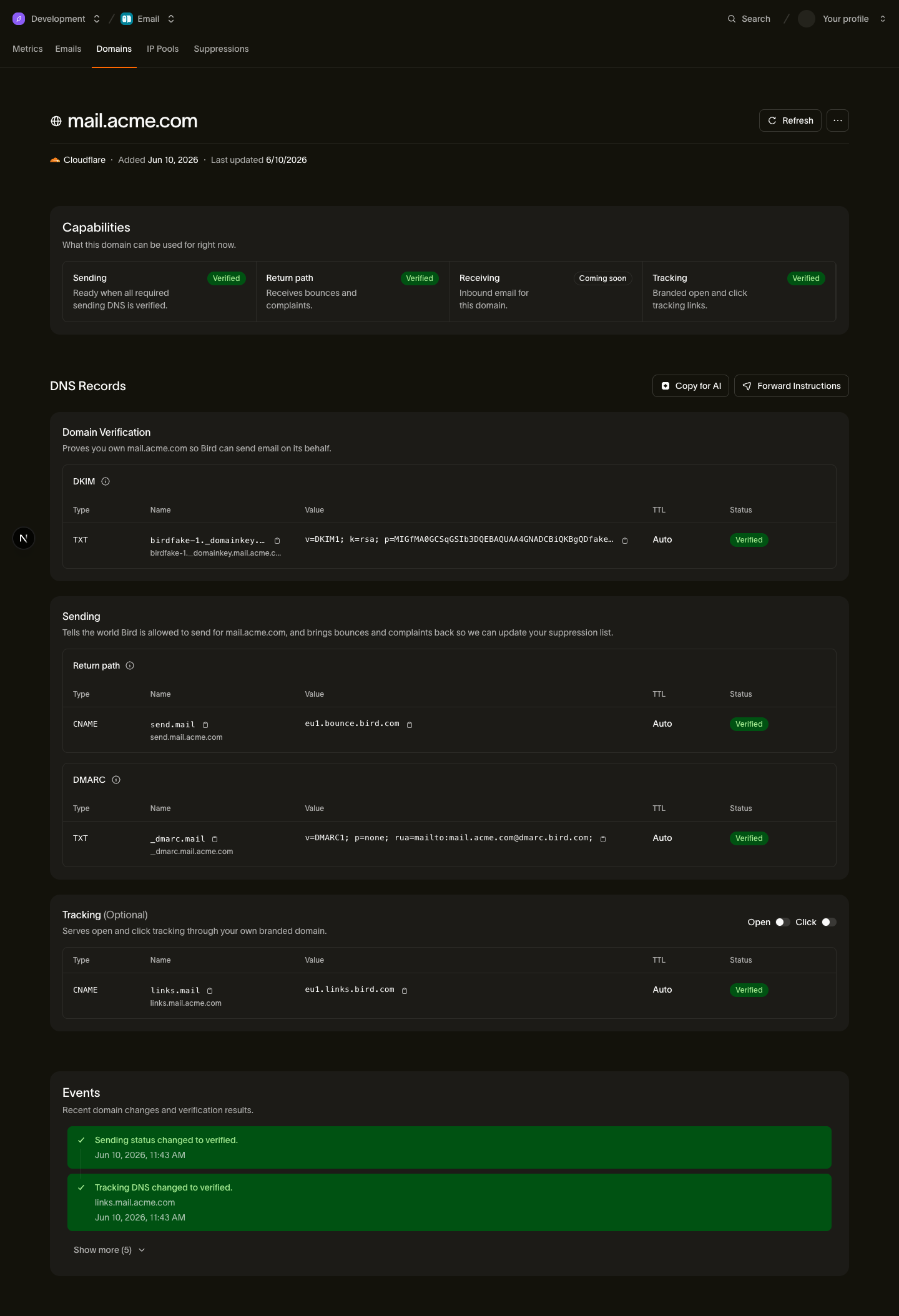
Adding a sending domain (in the dashboard or via the API) registers it against Bird's sending infrastructure and assigns your organization its own DKIM key. The domain starts in pending status, and you get the exact DNS records to publish:
- A DKIM TXT record: proves ownership and signs your mail.
- A return-path CNAME: routes bounces back to Bird and covers SPF.
- A DMARC policy: any valid
v=DMARC1record; a minimalp=nonepolicy is enough. - An optional tracking CNAME for branded open/click tracking (not required for sending).
DNS verification is automatic. A rejected status means Bird refused the domain for policy reasons. Select Help > Contact Support if you see it.
How verification runs
We check the records when you register the domain and continue re-checking automatically; see Sending domains for the verification schedule. Sending becomes available when DKIM, the return-path CNAME, and DMARC all verify.
After correcting a DNS record, select Refresh on the domain details page or call the verify endpoint for a current result.
How long it takes
Verification completes after Bird can resolve all required records. DNS propagation can take from minutes to 48 hours, depending on the provider and TTL.
If the domain remains pending, check for an incorrect host, a duplicated domain suffix, a truncated value, or a proxied CNAME. Use Why isn't my domain verifying? for the full checklist.
Verified is not forever
We continue checking verified domains automatically. If your DNS later breaks, the domain can flip back to unverified and stop sends until you restore the records. This can happen when a provider migration deletes a record or a zone change drops the DKIM TXT record.
To avoid blocking sends during a transient DNS problem, a previously verified record enters a warning grace period after the first failed check before its status changes to failed and sending stops; see Sending domains for the grace-period details. Any successful check clears the warning.
The practical advice: treat your sending-domain DNS records as production infrastructure. If you migrate DNS providers or restructure your zone, carry the DKIM, return-path, and DMARC records over first.
Next steps
- Sending domains: the full developer guide, covering the registration API, DNS record details, and the verification lifecycle.
- Why isn't my domain verifying?: diagnosing pending domains and DNS propagation.
Related resources
Continue with the documentation, guides and examples for this topic.