Key Takeaways
- Premise: Email notifications are a foundational component of SaaS product engagement, connecting app events to user actions and reinforcing trust through consistent, meaningful communication.
- Goal: Help product and growth teams understand which notifications matter most, how to design them strategically, and how they drive retention, reactivation, and user confidence.
- Highlights:
-
Purpose of notifications:
- Notifications keep users informed about key account or product events — from activation and onboarding to security alerts — while also prompting re-engagement.
- They’re not just transactional; they’re a core retention tool that helps users form habits around your app.
-
7 essential types of notifications:
- Activation emails – verify users, confirm intent, and establish trust.
- Welcome & onboarding messages – reinforce product value and accelerate user adoption.
- User invites & shares – drive viral growth and network effects in both B2B and consumer apps.
- Activity notifications – keep users in the loop and re-engage inactive ones with updates or reminders.
- Reports & dashboards – deliver insights outside the app, reminding users of the product’s tangible value.
- Password resets & 2FA – critical to accessibility and user security.
- Security & account alerts – safeguard trust and help prevent fraud or misuse.
-
Strategic prioritization:
- Not every event deserves an email. Over-messaging leads to fatigue and disengagement.
- Start by identifying your app’s “make-or-break” moments—points where the right notification can either retain or lose a user.
- Focus first on notifications that enable access (password resets, activations) and build trust (security setup, confirmations).
-
Design and timing principles:
- Notifications must be timely, contextually relevant, and frictionless to act upon.
- Each message should reinforce the user’s decision to keep engaging with the product, not just convey data.
-
Business impact:
- Thoughtfully designed notification systems improve conversion, retention, and user confidence.
- They also reduce support costs by automating key communications like account access and updates.
-
Email notifications are an integral part of SaaS product strategy and development. They convey essential information, drive app activity and visits, and nurture user relationships.
What are email notifications?
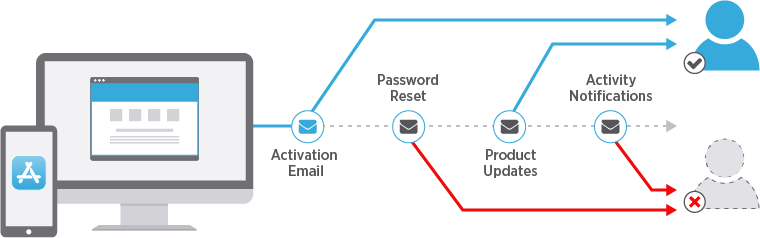
Email notifications are a type of triggered email—email that’s sent in response to specific user action or other event. Dating apps like Tinder and Hinge have mastered this approach—learn how they use triggered emails to boost user engagement. For SaaS applications and web sites, common examples of these app-generated emails include activation and welcome messages, activity notifications, account and security alerts, and utilitarian functions like password resets.
These notifications serve an important purpose—alerting us when a post was shared on social media, reminding us to take action on a personal account, or asking us to approve payment for goods and services.
Beyond these purely functional needs, notifications also are a valuable communication tool that enables product teams to directly engage with their customers. They are a persuasive instrument for drawing users back to using apps that they might have forgotten about. For a real-world example, see how dating apps use triggered emails to re-engage users and drive them back to their platforms. They help deliver a great user experience and are one of the most influential tools that product management teams have to drive conversion, retention, and growth. Additionally, and perhaps most importantly, they reinforce trust in services and help to build long-lasting relationships between a SaaS business and its customers.
7 essential types of email notifications
**Summary of the 7 essential email notification types
**
| Notification Type | Primary Purpose | Typical User Impact |
|---|---|---|
| Activation emails | Verifies email and enables account use | Confirms user identity and begins activation |
| Welcome & onboarding | Reinforces core value and helps users get started | Accelerates initial engagement |
| User invites & shares | Enables collaboration and viral growth | Expands team participation and network effects |
| Activity notifications | Alerts users to updates or incomplete tasks | Boosts re-engagement and keeps workflows moving |
| Reports & dashboards | Provides periodic insights outside the app | Reminds users of ongoing product value |
| Password resets & 2FA | Enables access and protects accounts | Critical for usability and security |
| Security & account alerts | Prevents fraud and misuse | Reinforces trust and transparency |
Understanding what types of email notifications to use throughout various touchpoints of the customer journey can be critical to a product or app’s success. Below, are the essential email notification types product and app teams use when communicating with customers at various instances of user engagement.
Activation emails are sent as soon as a new user creates an account. It’s the first email notification your users will receive, and is a critical path step towards user activation. For many services, users very literally cannot use the app until an account has been activated by clicking a link in the email.Activation emails serve to verify that the email address the user provided is valid and working. They also remind users that they chose to sign-up for your product, an important step in making the difference between a genuine user and a “drive-by” signup.
Welcome and onboarding messages are sent once a user has verified their email address to activate a new account. Most often, a welcome message is sent as soon as an account has been activated. For FinTech companies specifically, optimizing email onboarding campaigns requires special consideration given the sensitive nature of financial services and customer psychology around money management. Welcome messages reinforce a service’s core promises, set the tone for future interactions, and say thanks for joining. One or more onboarding messages are sent to help users explore and get started with the product. Whether timed or triggered by specific actions, these emails provide information and prompt users to get up and running—and to accelerate their pace to become active, engaged users.
User invites and shares are are a core email for consumer and B2B apps alike. Both contribute to viral, word-of-mouth growth. Explicit invitations asking colleagues to join a project team are essential for many categories of services and are a notification example that product teams must consider implementing. Although shares are very often associated with social networks and similar consumer services, they also have a place in many B2B contexts. Document sharing and other forms collaboration are common examples. It is worth noting that shares also play the role of an implicit invitation to join when sent to a new user.
Activity notifications are an important tool for alerting users to changes in workflows and for integrating in-app activity with many users’ primary environment, their email inbox. They also are an effective way of reengaging passive users who might not be using the app on a regular basis.These messages can be triggered by explicit events or sent on a scheduled basis, depending upon the context. Typical examples include reminders to complete a task or a summary of missed social media notifications.
Reports and dashboards are especially important for B2B services. The information they contain is essential for users and their teams to keep tabs on the business processes they manage.Like other forms of activity notifications, these messages reinforce engagement for users who may not be active in the app itself. And well-designed reports and dashboards are an effective way of explicitly reminding users and their executive decision-makers of a service’s value.
Password resets and two-factor authentication are examples of utilitarian notifications that every app must implement reliably. Like activation emails, they’re quite literally the sort of product email can make or break a user’s ability to use a service.
Security and account alerts are an essential aspect of helping users to protect their accounts. They’re a crucial bulwark against fraud, misuse, and the theft of sensitive information and credentials.
Where to prioritize email notifications in your app
Users value notifications when they’re relevant, but quickly learn to ignore, delete, or even flag as spam messages that are repetitive or don’t add value to how they interact with an app.
But that still leaves a question for product teams. Deciding where to begin with notifications can be daunting. It’s important to make strategic choices about which to send, and how often.Notifications and reminders help your users navigate their “make or break” moments and are essential emails your product must send.
Notifications and reminders help your users navigate their “make or break” moments and are essential emails your product must send.
Identifying your product’s key “make or break” moment(s) is a good place to begin. Notifications and reminders about these points are among the most essential emails your product can send. This notification can help keep a user engaged, or potentially lose them and cause an app to be forgotten. A password reset or a prompt to update a product is a vital example of this type of notification. Both need action from a user to continue their usage of an app, and if not sent correctly and quickly, can result in a permanent loss of business.
Similarly, the security config email is one that product leaders should focus on. You never get a second chance to make a good first impression, and this type of notification sets the scene for the service that users will experience. The right security set-up notification helps to instill trust in the relationship between user and product, reassuring them that their data will be safe with the use of techniques such as two-factor authentication.
Q&A
What’s the role of email notifications in SaaS?
They bridge the gap between in-app experience and user awareness, ensuring customers stay engaged and informed at critical moments.
Which types of notifications should come first?
Start with activation, onboarding, and security messages — these directly affect user trust and access to your product.
How do notifications influence retention?
Timely reminders, reports, and updates bring users back into the app, preventing churn due to inactivity or missed actions.
How can you avoid overwhelming users?
Segment events by importance and frequency; prioritize messages that add value or require action.
Why are security and account alerts so critical?
They build confidence in your platform’s reliability, directly influencing user perception of safety and professionalism.
How do triggered emails connect to engagement strategy?
Triggered notifications turn behavior into a feedback loop — every meaningful action can lead to a reinforcing message that strengthens user habits.