Omnichannel marketing: Everything you need to know
Omnichannel
Guide Takeaways
The customer journey is non-linear and spans many touchpoints and channels
Omnichannel marketing connects every channel into one seamless customer experience
It relies on consistent messaging, shared data, and integrated tools
Multichannel ≠ omnichannel — the latter is connected, consistent, and customer-centric
A strong strategy improves conversions, engagement, and total customer value
Success requires clear objectives, channel selection based on customer behavior, and the right tech stack
Analytics help identify what content, channels, and touchpoints drive the most value
Omnichannel campaigns become even more effective through automation, personalization, and real-time data
Leading brands use WhatsApp, chatbots, push, email, and social in tightly integrated ways
Future trends: fewer cookies, more embedded experiences, and smarter AI/chatbots
Q&A Highlights
What is omnichannel marketing?
It’s a customer-centric approach where every channel works together to deliver one consistent, seamless experience across the entire buying journey.
How is omnichannel different from multichannel?
Multichannel uses many channels independently. Omnichannel connects them, keeps messaging consistent, and uses shared data to personalize every touchpoint.
Why does omnichannel improve performance?
Integrated experiences increase engagement, improve conversions, and drive higher customer lifetime value.
Which channels are most effective?
It depends on customer preference, but WhatsApp, SMS, email, push, and social are commonly high-impact.
What tools do you need for omnichannel marketing?
A CDP, a unified messaging/marketing platform, automation workflows, content creation tools, and cross-channel analytics.
How do you design an omnichannel campaign?
Define clear objectives, choose the right channels, map the customer journey, create consistent content, and automate where possible.
How does omnichannel analytics help?
It reveals top-performing channels, customer behavior patterns, conversion paths, and areas that need optimization.
What future trends should marketers prepare for?
The shift to first-party data, embedded experiences in messaging apps, and smarter AI-powered chatbots.
We are so used to thinking of marketing as funnels and conversions. Yet the truth is that in reality the buying journey is all but linear and doesn’t take place in isolated interactions.
From learning about your products, to purchasing, and coming back for more your customer goes through different learning curves, touchpoints, and channels.
Fail to internalize this bigger picture and you risk getting stuck in an endless loop of incremental optimizations limited by the bounds of each channel. Meanwhile businesses who take an integrated approach, reap the benefits of compounding results over time.
Omnichannel marketing is a more cohesive approach to marketing. It’s marketing that takes into account historical interactions, customer preferences, and seamlessly weaves experience across channels.
Omnichannel marketing, when done right, will do wonders for your business across the entire customer journey, from generating more leads to increasing conversions and improving retention rates.
The term “omnichannel marketing” is thrown around a lot though and can often be misunderstood.
So, let’s take a deep dive into the concept and explore its fundamental components to help you get started.
Omnichannel marketing is an approach to marketing in which you engage and convert customers on whatever channel suits the customer, while ensuring an experience that is:
Consistent
Smooth
Personalized
…from the first touchpoint till the last.
The key characteristic is that the entire journey feels coherent in terms of the content, tone, and voice, along with any contextual information based on any previous interactions with your customers.
Omnichannel marketing delivers a streamlined experience by integrating customer data from different channels and tools. The combined data works together to create a uniform presence for your brand everywhere.
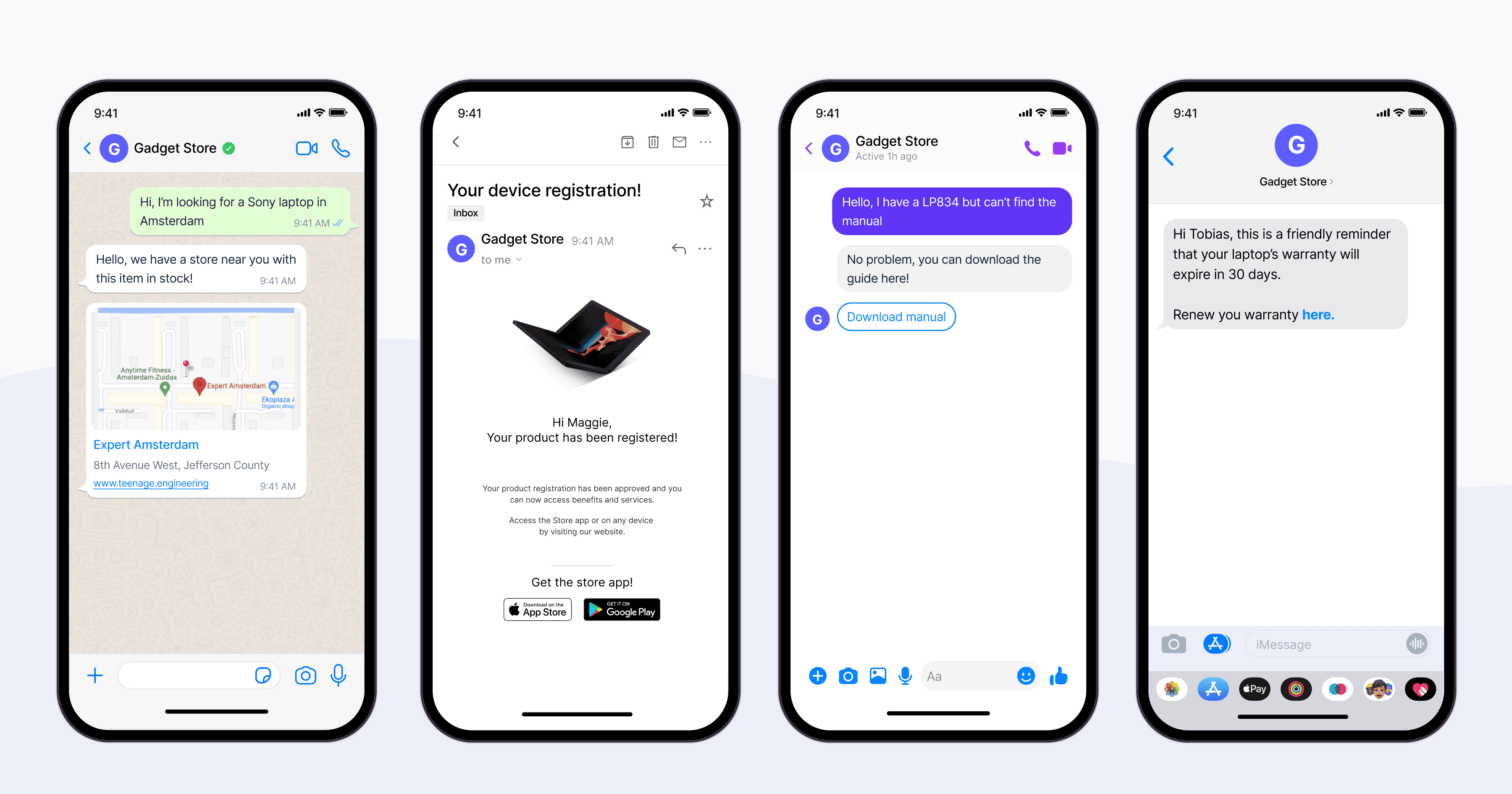
For instance, suppose a customer buys a laptop from your online store. With an omnichannel process in place, you could send timely messages promoting your shop’s laptop insurance coverage and related products (like a bag or a stand). The result: a contextual upsell path powered by automation and real-time data. This clockwork is what omnichannel marketing strives for.

Omnichannel and multichannel marketing are different, despite sharing a key characteristic. Multichannel marketing simply refers to marketing to customers using more than one channel. Omnichannel marketing takes multichannel marketing one step further by making sure that every channel is interconnected, resulting in a uniform experience everywhere. In that sense, every omnichannel marketing approach is multichannel, but not every multichannel approach is omnichannel.
Here are some key differences that help distinguish between the two:
Concept | Multichannel | Omnichannel |
|---|---|---|
Channel behavior | Channels operate independently | Channels are interconnected and share data |
Experience | Often inconsistent and siloed | Unified, consistent, and customer-centric |
Goal | Use as many channels as possible | Use only the channels customers prefer |
Focus | Reach | Experience + personalization |
Channel integration — In multichannel marketing, all channels typically operate in their own silos and have their own strategies to engage the customers. With an omnichannel approach, all channels, along with your entire marketing tech stack, must be integrated. This interconnectivity creates an ecosystem of channels that puts the customer at the center, allowing them to move seamlessly through the buyer’s journey.
Consistency — The goal of a multichannel approach isn’t to offer a unified experience but to simply cast a wider net. As a result, the experience feels disjointed at times. Omnichannel marketing, however, focuses on delivering a uniform, consistent experience everywhere by leveraging customer data and following the same brand guidelines.
The priority — Multichannel marketing seeks to maximize the number of channels that a business uses to market to its customers. Omnichannel marketing, by contrast, focuses on strategically using the channels that your customers prefer to maximize your return on investment. It makes your marketing efforts customer-centric by engaging them where they are.
Taking an omnichannel approach requires a lot of planning and internal alignment of the entire marketing team. But the returns are far greater than what any multichannel approach can offer in terms of user experience and engagement — all of which ultimately result in higher revenue. Here are a few interesting omnichannel marketing statistics on how effective it is:
Advertising impact improves by 35% when different marketing channels work together. This is only possible with a true omnichannel approach built around integrations. The smooth journey, delivered end to end across different channels as a result of this interconnectivity, creates better omnichannel experiences, leading to higher conversions.
Omnichannel customers spend 10X more than digital-only customers. A digital-only approach to marketing — even in this modern day and age — won’t necessarily yield the highest ROI. The best approach is to strike the right balance between the traditional and digital avenues at your customers’ disposal.
Businesses that don’t offer customers the flexibility to purchase their products wherever they want lose around 10-30% in sales. You’ll see an immediate positive impact on your business bottom line by expanding the number of channels your customers can use to buy your products.

The stats above provide a mere glimpse of the massive potential of omnichannel marketing. Businesses achieve a lot more with the right processes and tools.

Omnichannel marketing analytics is the strategic approach to using data related to your campaign’s performance and customer behavior to improve your omnichannel initiatives. It involves pulling data from various sources — such as your customer relationship management (CRM) tool, point-of-sales (POS) software, and CDP — and analyzing it to make informed decisions about your campaigns.
You can uncover a myriad of insights by tapping into your omnichannel analytics:
The best channels to reach your customers
The best content types to engage with your customers
Vital customer information to personalize their customer experiences
Crucial customer touchpoints that result in conversions
The products and services that perform the best
These insights, when put into action, go a long way toward making your marketing initiatives more effective. Here are some actionable tips on how to make that happen:
Look for patterns and form your hypotheses — Is there anything that keeps resurfacing when analyzing your data? For instance, there could be a specific channel that’s often attributed to customer engagement. Or you find that most of your customers typically convert after a certain number of touchpoints. Use these patterns to form your hypotheses for what works best for your customers.
Test your hunches — A/B test your campaigns to see if your initial hypothesis is true or not. That’s because the hypothesis formed from the initial analysis could be a result of outliers or special cases. Making any large-scale decisions without first actively testing them out could be detrimental to the performance of your campaign.
Rinse and repeat — Customer preferences and behaviors keep on changing. To that end, it’s vital to consistently look at your omnichannel marketing data to look for any patterns that you can leverage to make better decisions.