Breaking down email activity during Black Friday and Cyber Monday 2022 (and what you can do to beat the averages)
·
Key Takeaways
Holiday email volume spikes dramatically during Black Friday and Cyber Monday, with Bird sending 3.2 billion emails per day on each event — far above the seasonal baseline.
Across eight retail verticals, a global permissioned panel observed 16 billion total emails, with inboxing rates of 90%+ for nearly every category.
Read rates (open proxy) clustered around 12–14%, with Retail/Department Stores leading and Jewelry/Watches performing lowest.
Despite their visibility, Black Friday/Cyber Monday–themed messages made up less than 16% of all emails sent in the period — most Holiday performance is driven by non-BFCM targeted and personalized campaigns.
Holiday promotions now begin earlier each year, often surfacing before September, with Cyber Monday stretching into “Cyber Week” and December.
Optimizing inbox placement and engagement is crucial — even a 1% lift in inboxing can generate ~5% revenue uplift.
Marketers can beat industry averages by strengthening permissioning, welcome flows, hygiene, relevance, and engagement-based segmentation.
Q&A Highlights
How much did email volume increase on Black Friday and Cyber Monday?
Bird deployed 3.2 billion emails on each day — up from the two-week average of 2.4 billion leading into Black Friday.
How many total emails were observed across retail verticals?
A permissioned global panel observed 16 billion emails across eight retail categories.
How did inboxing perform across categories?
Most verticals achieved 90%+ inbox rates, with Sporting Goods being the primary exception.
What were the typical read (open) rates?
Across categories, read rates clustered around 12–14%, with Retail/Department Stores performing best.
Are BFCM-themed emails the main driver of Holiday engagement?
No. BFCM-themed sends represented under 16% of each vertical’s total volume — targeted, personalized Holiday emails drive more engagement.
Why do retailers start Holiday promotions earlier now?
Amazon sets the pace by launching seasonal campaigns early, while supply chain concerns and competitive pressure contribute to earlier Holiday messaging.
How long does “Cyber Monday” marketing last today?
It has evolved into Cyber Week or Cyber Days, often extending well into December.
When does the Holiday email season really end?
Not on December 25. Post-Christmas clearance activity typically continues through much of January.
Why does inbox optimization matter so much during Holiday?
Deliverability and engagement are tightly linked. Messages that don’t reach the inbox cannot generate opens, clicks, or revenue.
How much revenue impact can inbox improvements create?
Even a 1% improvement in inboxing can drive 5%+ revenue gains for email-monetized programs.
What subscriber acquisition practices help inboxing?
Use active opt-in, send immediate welcome emails, avoid passive or purchased lists, and make opt-out/permissioning clear.
What targeting strategies reduce spam complaints and boost engagement?
Deliver highly relevant, behavior-based messages using data such as browsing, purchase history, preferences, location, and lifecycle stage.
To Begin
With 2022’s Black Friday and Cyber Monday behind us, and two more weeks left in December, let’s look at what we can see of Holiday-related retail email thus far, and share key insights and email best practices for successfully supporting Holiday.
For retailers, there is no more important season than the Christmas Holiday period, which mostly comprises November and December. Depending on the retail vertical, Holiday can generate up to 35% of annual retail sales, and drive an even larger percentage of annual profits. Email marketing has become an enormous supporter of the Holiday promotional effort.
Conventional wisdom places the gateway to Holiday as the Black Friday/Cyber Monday weekend period, immediately following the U.S. Thanksgiving holiday. And in fact, supporting that entry is where we see the bulk of related email activity truly ramp up.
What We’re Seeing
Bird deployed about 3.2 billion emails this year on behalf of senders on each of Black Friday and Cyber Monday. This is up from the two-week average of 2.4 billion prior to Black Friday.
And that’s only what Bird sent. The table below shows sixteen billion total Black Friday and Cyber Monday emails observed across eight retail verticals in a permissioned global consumer panel whose email we track.
Black Friday / Cyber Monday themed emails (10/15–12/1) | # of campaigns | % of total period campaigns | Deployed emails (000) | Inbox % | Read rate % |
|---|---|---|---|---|---|
Apparel & Accessories | 14,564 | 11% | 4,218,435 | 90.5 | 13.9 |
Consumer Electronics | 3,759 | 13% | 1,789,933 | 91.7 | 13.3 |
Gifts & Remembrances | 2,642 | 11% | 771,695 | 89.7 | 12.7 |
Jewelry & Watches | 3,361 | 14% | 724,705 | 90.2 | 11.9 |
Online Shopping | 4,631 | 5% | 2,815,552 | 90.8 | 13.6 |
Retail & Department Stores | 1,749 | 7% | 4,465,009 | 89.9 | 14.2 |
Sporting Goods | 5,582 | 16% | 1,186,629 | 88.5 | 14.1 |
Toys & Games | 813 | 14% | 108,351 | 91.3 | 13.5 |
Total | 37,101 | 10% | 16,080,309 | 90.3 | 13.4 |
(*Note: Read Rate is our proxy for Open Rate.)
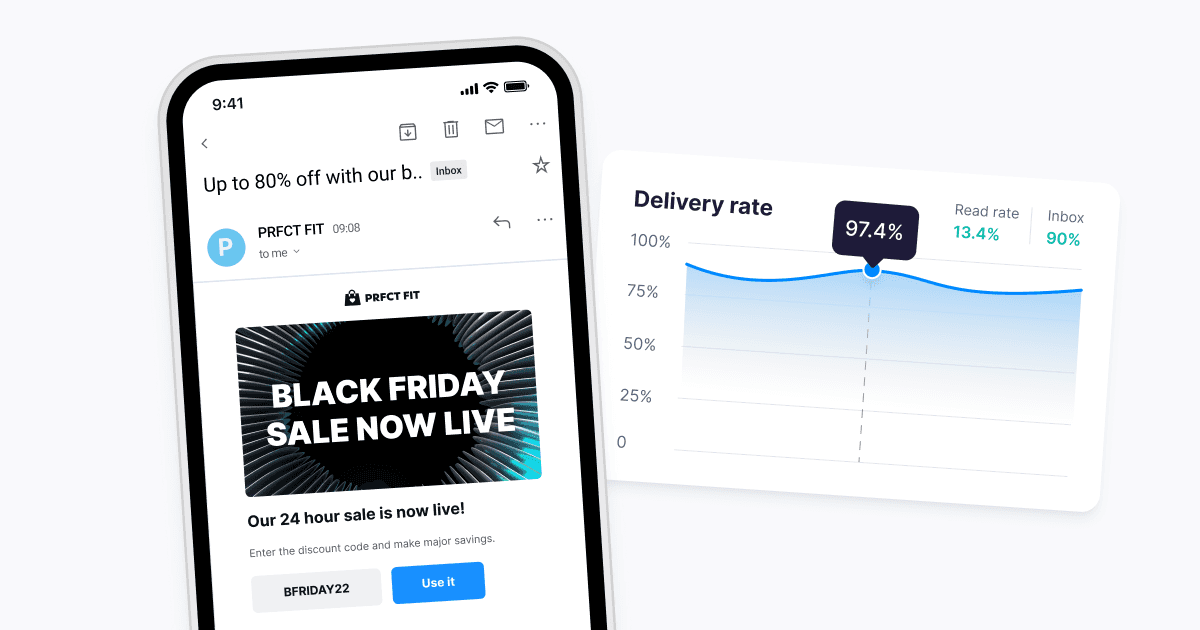
Black Friday and Cyber Monday themes are extensively used in early Holiday email. The highest volumes were sent by Apparel, Accessories, Retail and Department Stores (4.2m and 4.4m respectively); Toys and Games sent the lowest. Excepting Sporting Goods, all categories drove inboxing to 90% or higher. Read rates cluster in the 12-14% range, with Retail and Department Stores the highest, and Jewellery and Watches the lowest.
However, Black Friday/Cyber Monday themed emails are only a small share of total volumes being deployed by these senders during this period. None of these verticals have Black Friday/Cyber Monday themed mailings that exceed 16% of the respective vertical’s total emails for the period analyzed.
That distinction is important. Black Friday/Cyber Monday-themed mailings tend to be promotional, with aggressive discount offers. These are less focused on individual merchandise categories curated and personalized for specific customer segments. The more targeted approach usually reflects other Holiday period mailings. As a result, the latter also tend to drive somewhat higher subscriber engagement.
Key Takeaways
One noteworthy takeaway from our observations is the importance of recognizing the realities of event timing in planning Holiday email activity.
Amazon, with its massive audience, market dominance and email sophistication, has typically launched their seasonal campaigns long before most other retailers. Competitors need to be aware of this pattern and plan accordingly.
Even aside from “Black Friday” having long ago been co-opted by almost everyone as a year-round promotional device, the fact is that Black Friday and other Holiday promotions are appearing earlier and earlier in the retail’s fall season. We’re seeing evidence of increasing Holiday references even before September. Concerns about supply chain issues may account for some of this earlier emphasis.
“Cyber Monday” references and promotions now typically extend into “Cyber Week” or “Cyber Days,” visible well into December.
Finally, the retail Holiday season doesn’t end on December 25th. With post-Christmas clearance and other promotional events, related activity usually extends through much of January.